
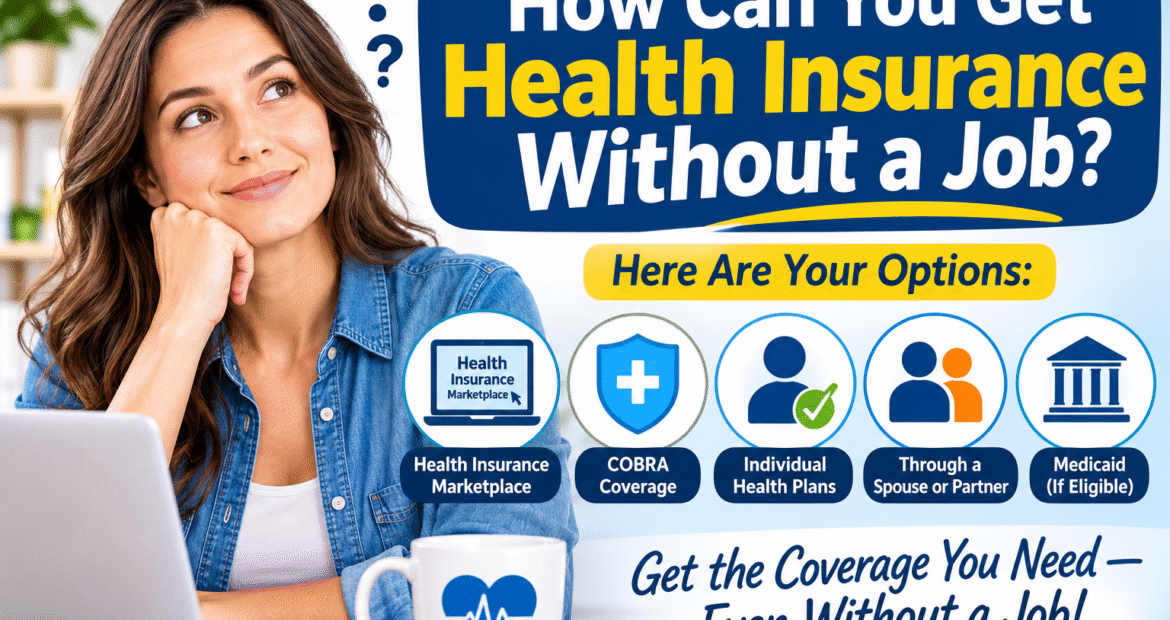
Losing a job can create several financial challenges, especially when your employer previously provided health insurance. Without regular income, paying for doctor visits, prescription medications, hospital treatment, and other medical expenses can become difficult. This situation often leaves people wondering, how can you get health insurance without a job?
The good news is that employment is not a requirement for getting health insurance in the United States. You can explore several options, including government health insurance programs, Affordable Care Act (ACA) Marketplace plans, COBRA continuation coverage, and insurance through a spouse or family member.
Your eligibility and monthly costs will generally depend on factors such as household income, family size, age, location, and other personal circumstances.
Whether you recently lost your job, work independently, are between jobs, or have no current income, understanding these options can help you find suitable medical coverage without relying on an employer.
This guide explains the available health insurance options, how to apply, what they may cost, and how to choose coverage that fits your financial situation.
Table of Contents
- Can You Get Health Insurance Without a Job?
- What Are the Best Health Insurance Options Without Employment?
- How to Get Health Insurance Without a Job: Step-by-Step Process
- Can You Get Free Health Insurance If You Have No Income?
- How Much Does Health Insurance Cost Without a Job?
- What Happens to Your Health Insurance After Losing a Job?
- Can You Get Health Insurance Without a Job Through a Family Member?
- What Should You Consider When Choosing a Health Insurance Plan?
- Common Mistakes to Avoid When Getting Health Insurance
- Frequently Asked Questions
1. Can You Get Health Insurance Without a Job?
Yes, you can get health insurance without having a job in the United States. Health insurance is available through government programs, private insurance companies, and family coverage arrangements.
You do not need to be employed full-time or receive employer benefits to purchase an individual health insurance policy.
In fact, the Affordable Care Act (ACA) allows eligible individuals to purchase health insurance through the federal or state Health Insurance Marketplace, even when they are unemployed.
Depending on your financial situation, you may qualify for:
- Medicaid, which provides free or low-cost health coverage to eligible individuals.
- ACA Marketplace insurance, with financial assistance available to eligible applicants.
- COBRA, which allows certain former employees to temporarily continue their previous employer-sponsored coverage.
- A spouse’s or parent’s employer-sponsored insurance plan.
- Private health insurance purchased directly from an insurance company.
Your employment status alone does not determine whether you qualify for coverage. Your household income, family size, state of residence, and other eligibility requirements are important.
For example, someone who recently lost a full-time job may qualify for Medicaid or receive financial assistance through the Marketplace. Another person who has savings or income from freelance work may qualify for an individual Marketplace plan.
2. What Are the Best Health Insurance Options Without Employment?
If you are unemployed, comparing different coverage options is an important first step. Each option has different eligibility requirements, costs, and benefits.
A. Medicaid: Government Health Insurance for Eligible Individuals
Medicaid is one of the most important health insurance options for people who have limited income or are currently unemployed.
It is a joint federal and state government program that provides health coverage to eligible individuals and families.
Depending on your eligibility, Medicaid may cover services such as:
- Doctor visits and preventive healthcare.
- Hospital treatment.
- Emergency medical services.
- Prescription medications.
- Laboratory tests.
- Mental health services.
- Certain pregnancy and maternity services.
One major advantage is that eligible individuals can generally apply for Medicaid throughout the year. You do not have to wait for the annual Marketplace Open Enrollment Period.
However, Medicaid eligibility rules vary by state.
In states that expanded Medicaid, many adults with lower household incomes can qualify based primarily on income. In other states, eligibility may depend more heavily on factors such as disability, pregnancy, family circumstances, and other qualifying categories.
If you have recently lost your job and your income has decreased, check your state’s Medicaid eligibility requirements.
B. ACA Health Insurance Marketplace Plans
The ACA Health Insurance Marketplace is another useful option for people who do not have employer-sponsored insurance.
Through the Marketplace, you can compare private health insurance plans offered by participating insurance companies.
You may qualify for financial assistance that reduces your monthly insurance premium. Depending on your income and eligibility, you may also qualify for additional savings on deductibles, copayments, and other out-of-pocket expenses through eligible plans.
Marketplace plans generally offer essential health benefits, including:
- Emergency services.
- Hospitalization.
- Prescription drug coverage.
- Mental health and substance use disorder services.
- Maternity and newborn care.
- Preventive and wellness services.
- Laboratory services.
- Pediatric services.
One important benefit is that Marketplace insurers cannot refuse coverage or charge higher premiums because of pre-existing health conditions.
Your eligibility for financial assistance is generally based on household income and other factors, not simply whether you are employed.
C. COBRA Health Insurance
If you recently lost a job that provided health insurance, COBRA may allow you to continue using your previous employer-sponsored health plan temporarily.
COBRA stands for the Consolidated Omnibus Budget Reconciliation Act.
It allows eligible employees and certain family members to continue their existing group health coverage after qualifying events, including job termination or a reduction in working hours.
The main advantage is continuity. You may be able to keep the same doctors, hospitals, and health plan benefits.
However, COBRA can be expensive because you generally have to pay the full group insurance premium yourself, including the portion previously paid by your employer, plus an administrative fee of up to 2%.
For many eligible people, continuation coverage generally lasts up to 18 months after employment ends, although certain circumstances allow longer coverage.
You should compare the COBRA cost with available Marketplace plans before making a decision.
D. Private Health Insurance
You can also purchase private health insurance directly from an insurance company or through an authorized insurance agent.
This option may be useful if you want to compare different insurance products, provider networks, and coverage arrangements.
However, there is an important distinction between ACA-compliant health insurance and other private insurance products.
Not every plan sold outside the Marketplace provides the same protections and essential health benefits as ACA-compliant coverage.
For example, some short-term medical plans may exclude pre-existing conditions, limit certain benefits, or provide less comprehensive protection.
Also, purchasing insurance directly from an insurer does not automatically make you eligible for Marketplace premium tax credits.
Before purchasing a private plan, carefully review its exclusions, deductibles, annual limits, prescription benefits, and provider network.
E. Health Insurance Through a Spouse or Family Member
If your spouse has employer-sponsored health insurance, you may be able to join their plan even if you are unemployed.
Losing your own job-based health coverage generally creates a special enrollment opportunity to join an eligible spouse’s employer plan.
You usually have 30 days from losing your previous coverage to request special enrollment.
If you are under 26, you may also be eligible to remain on or join a parent’s health insurance plan, subject to applicable plan enrollment rules.
This can be a convenient option for people who want to maintain access to employer-sponsored benefits without purchasing a separate individual policy.
3. How to Get Health Insurance Without a Job: Step-by-Step Process
Finding health insurance without employment does not have to be complicated. Following a few practical steps can help you identify the right coverage.
Step 1: Calculate Your Household Income
Start by estimating your expected household income for the coverage year.
Even if you are currently unemployed, you may have other sources of income, such as:
- Freelance earnings.
- Self-employment income.
- Unemployment compensation.
- Investment income.
- Retirement income.
- Other taxable income.
Marketplace financial assistance is generally determined using your projected household income for the coverage year, rather than simply checking whether you currently receive a paycheck.
Make sure your estimates are accurate and update your application if your financial circumstances change.
Step 2: Check Your Medicaid Eligibility
If your income has decreased significantly after losing employment, check whether you qualify for Medicaid.
Eligibility depends on your state, household size, income, and applicable program rules.
If you qualify, Medicaid may provide comprehensive health coverage at little or no cost.
You can apply through your state Medicaid agency or use the Marketplace application to determine whether Medicaid is available to you.
Step 3: Compare ACA Marketplace Plans
If you do not qualify for Medicaid, explore Marketplace insurance.
Visit HealthCare.gov and provide the requested household, income, and personal information.
The Marketplace will show available plans and whether you qualify for financial assistance.
Compare the monthly premiums, deductibles, copayments, provider networks, and prescription coverage before choosing a plan.
Step 4: Review Your COBRA Eligibility
If you lost employer-sponsored coverage, review the COBRA information provided by your former employer.
Compare its monthly premium with the cost of Marketplace insurance.
Remember that COBRA may preserve your existing benefits, but you will generally pay the full premium yourself.
Step 5: Complete Your Application
Once you identify a suitable option, complete the relevant application.
You may need information such as:
- Social Security numbers, where applicable.
- Household member details.
- Expected annual income.
- Current or previous insurance information.
- Immigration or residency documentation, if requested.
The exact documents depend on the program and your circumstances.
Step 6: Confirm Your Coverage Start Date
Do not assume that submitting an application means your health insurance has already started.
Review your eligibility decision, enrollment confirmation, effective date, and any first premium payment requirements.
If you select a private Marketplace plan, pay the first premium by the insurer’s deadline.
Confirm that your coverage is active before scheduling medical treatment that depends on insurance benefits.
4. Can You Get Free Health Insurance If You Have No Income?
Yes, you may qualify for free or low-cost health insurance if you have no income, but eligibility depends on where you live and your personal circumstances.
Medicaid is generally the first program to investigate if you have little or no household income.
However, having zero income does not automatically guarantee Medicaid eligibility in every state.
How Does Medicaid Work If You Have No Income?
In states that expanded Medicaid, eligible adults with low incomes may qualify even if they do not have children or a disability.
In states that have not expanded Medicaid, adults without children may face more restrictive eligibility requirements.
Other factors, including pregnancy, disability, age, and family circumstances, can also affect eligibility.
What If You Do Not Qualify for Medicaid?
If Medicaid is unavailable to you, explore the ACA Marketplace.
Your eligibility for Marketplace savings depends on several factors, including projected household income, household size, state, and applicable federal rules.
One important consideration is that people with income below the applicable threshold may not qualify for Marketplace premium tax credits in certain states if they are not eligible for Medicaid.
This is sometimes called the Medicaid coverage gap.
For this reason, it is important to check both Medicaid and Marketplace eligibility rather than assuming that having no income automatically means you can receive a subsidized private plan.
Can You Get Medical Care Without Insurance?
If you cannot afford health insurance, you still have options for accessing medical services.
Community health centers provide primary healthcare services to people regardless of their ability to pay. Many use income-based sliding fee scales.
These centers can help with routine medical appointments, preventive care, and certain other healthcare needs.
5. How Much Does Health Insurance Cost Without a Job?
The cost of health insurance without employment varies considerably.
Some people qualify for Medicaid with little or no monthly premium. Others purchase Marketplace coverage and receive financial assistance that reduces their monthly costs.
If you buy private coverage without financial assistance, you generally pay the full premium yourself.
Several factors influence the cost.
Factors That Affect Health Insurance Costs
Age: Older applicants generally pay higher premiums than younger applicants, within applicable rating rules.
Location: Insurance premiums differ by state, county, and insurance market.
Household income: Your income can affect eligibility for Marketplace financial assistance and Medicaid.
Plan category: Marketplace plans are commonly grouped into Bronze, Silver, Gold, and Platinum categories.
Deductible: A plan with a lower monthly premium may have a higher deductible, meaning you pay more before certain benefits begin paying.
Family size: Covering multiple family members usually costs more than purchasing individual coverage.
Understanding Different Marketplace Plans
| Plan category | General characteristics |
|---|---|
| Bronze | Lower monthly premiums and higher out-of-pocket costs |
| Silver | Moderate premiums and costs; may provide extra savings for eligible applicants |
| Gold | Higher premiums and generally lower out-of-pocket costs |
| Platinum | Higher premiums and generally lower costs when receiving covered care |
These categories describe how costs are generally shared between the insurance company and the policyholder. They do not indicate the quality of medical treatment.
If you qualify for cost-sharing reductions, you generally need to select an eligible Silver Marketplace plan to receive those additional savings.
How Can You Reduce Your Monthly Premium?
Consider these strategies:
- Check Medicaid eligibility before purchasing private insurance.
- Compare multiple Marketplace plans.
- Provide accurate household income information.
- Check whether you qualify for premium tax credits.
- Compare deductibles and out-of-pocket maximums.
- Review available provider networks before selecting coverage.
Remember that the cheapest monthly premium is not always the most affordable option overall. Consider how much you might spend on medical services throughout the year.
6. What Happens to Your Health Insurance After Losing a Job?
When you lose your job, your employer-sponsored health insurance does not necessarily end on your final working day.
The actual termination date depends on your employer’s plan and benefits policy.
Some employers continue coverage until the end of the month in which employment ends, while others may use a different date.
Once your job-based insurance ends, you may qualify for a Special Enrollment Period through the ACA Marketplace.
Understanding the 60-Day Special Enrollment Period
If you lose job-based health insurance, you generally have 60 days before or after losing that coverage to enroll in a Marketplace plan through a qualifying Special Enrollment Period.
This applies even if you voluntarily quit your job or were dismissed, provided you lose your employer-sponsored health coverage.
Your Marketplace coverage can generally begin on the first day of the month after your previous job-based coverage ends.
For example:
Suppose your employer-sponsored health insurance ends on December 31.
You may be able to enroll in a Marketplace plan during the qualifying enrollment period so that your replacement coverage begins January 1, subject to enrollment and effective-date rules.
Can You Keep Your Previous Insurance?
Yes, if you qualify for COBRA, you may be able to continue your previous employer-sponsored health insurance temporarily.
However, you will generally need to pay the full premium yourself.
Before selecting COBRA, compare its costs with Marketplace insurance and any available financial assistance.
Important: Do not voluntarily cancel COBRA without checking your Marketplace enrollment rights. Ending COBRA early does not normally create a new Special Enrollment Period by itself.
7. Can You Get Health Insurance Without a Job Through a Family Member?
Yes. You may be able to receive health insurance through a family member even if you are not employed.
This can be an affordable alternative to purchasing an individual policy.
Through Your Spouse
If your husband or wife has employer-sponsored health insurance, ask whether the employer allows spouses to join the plan.
Losing your own employer-sponsored insurance generally gives you a special enrollment opportunity to join an eligible spouse’s plan.
Check the enrollment deadline because you usually have 30 days from losing your previous coverage.
Through Your Parents
If you are under 26, you can generally remain on or join a parent’s health insurance plan, even if you are unemployed, financially independent, or living separately.
There are specific rules for certain grandfathered plans, so check the plan documents.
Through Other Family Arrangements
Other family relationships do not automatically create eligibility for employer-sponsored health insurance.
For example, an adult sibling cannot generally add another adult sibling to a standard employer-sponsored plan simply because they are related.
Eligibility depends on the insurance plan’s dependent rules and applicable laws.
If family coverage is available, compare its premiums, provider network, deductibles, and coverage benefits with individual Marketplace insurance.
8. What Should You Consider When Choosing a Health Insurance Plan?
Choosing health insurance without a job requires careful planning because you may be responsible for paying the monthly premium yourself.
Before enrolling, consider the following factors.
Monthly Premium
The premium is the amount you pay every month to maintain your insurance coverage.
Choose a premium that fits your current financial situation without ignoring the coverage you may need.
Deductible
A deductible is the amount you generally pay for covered services before your insurance begins sharing costs, subject to the plan’s rules.
A lower-premium plan may have a higher deductible.
Out-of-Pocket Maximum
This is the maximum amount you generally pay for covered in-network essential health benefits during a plan year, excluding premiums and certain other expenses.
Understanding this amount can help you estimate your potential financial exposure.
Doctor and Hospital Network
Check whether your preferred doctors, specialists, hospitals, and clinics accept the insurance plan.
A low-cost policy may not be useful if it does not provide convenient access to your preferred healthcare providers.
Prescription Drug Coverage
If you regularly take prescription medication, review the plan’s drug formulary.
Check whether your medications are covered and whether additional copayments or restrictions apply.
Pre-Existing Conditions
ACA-compliant Marketplace plans cannot deny coverage or charge higher premiums because of pre-existing medical conditions.
This protection is particularly important for people who lose employer-sponsored coverage and need to purchase individual insurance.
9. Common Mistakes to Avoid When Getting Health Insurance
When looking for health insurance without employment, avoid these common mistakes.
1. Waiting too long to apply: If you lose employer-sponsored insurance, you generally have a limited 60-day Marketplace Special Enrollment Period. Missing the deadline may mean waiting for Open Enrollment unless another qualifying event occurs.
2. Choosing a plan based only on price: A low monthly premium may come with a high deductible or limited provider network.
3. Providing incorrect income information: Marketplace financial assistance depends on accurate income estimates. Report changes in your financial situation to avoid receiving incorrect assistance.
4. Assuming every private plan offers ACA protections: Short-term and limited-benefit plans may not cover the same services as comprehensive ACA-compliant insurance.
5. Ignoring COBRA: Even if COBRA appears expensive, it may be useful when you need continuity of care or want to maintain access to your existing doctors.
6. Forgetting to confirm coverage: Always check your enrollment confirmation and effective date before relying on your new insurance.
10. Frequently Asked Questions
1. How can you get health insurance without a job?
You can get health insurance without a job through Medicaid, ACA Marketplace plans, COBRA continuation coverage, or an eligible spouse’s or parent’s insurance plan. Your eligibility depends on your household income, location, age, and other circumstances.
2. What is the cheapest health insurance for unemployed people?
Medicaid is often the least expensive option for people who qualify, with free or low-cost coverage. If you do not qualify, an ACA Marketplace plan with eligible financial assistance may be more affordable than purchasing insurance at full price.
3. Can I get health insurance if I have absolutely no income?
Yes, you may qualify for Medicaid if you meet your state’s eligibility requirements. However, Medicaid availability varies by state. If you do not qualify, explore Marketplace coverage and community health centers.
4. Can I buy private health insurance without having a job?
Yes. You can purchase individual private health insurance without being employed. You may buy an ACA-compliant plan through the Marketplace or directly from an insurer. Financial assistance is generally available through the Marketplace rather than direct purchases.
5. Can unemployed people qualify for Obamacare?
Yes. Unemployed individuals can apply for ACA Marketplace coverage. Eligibility for premium tax credits and other financial assistance depends on household income, family size, location, and applicable eligibility rules.
6. How long can I stay on health insurance after losing my job?
If you qualify for COBRA, you can generally continue your previous employer-sponsored health coverage for up to 18 months, although certain qualifying circumstances allow longer periods. You may also qualify for Medicaid or Marketplace coverage.
7. Can I get health insurance if I am self-employed?
Yes. Self-employed individuals, freelancers, and independent contractors can purchase individual health insurance through the ACA Marketplace or directly from insurance companies. Their eligibility for financial assistance depends on household income and other factors.
8. Do I qualify for Medicaid if I receive unemployment benefits?
You may qualify. Unemployment compensation is generally included when determining income for Medicaid eligibility, but the exact outcome depends on your state, household circumstances, and applicable program rules.
9. Is COBRA better than Marketplace health insurance?
Neither option is automatically better. COBRA allows you to continue your previous employer-sponsored coverage, but you generally pay the full premium. Marketplace plans may offer lower costs if you qualify for financial assistance. Compare premiums, deductibles, doctors, and benefits before choosing.
10. Can I get health insurance immediately after losing my job?
You may be able to enroll in Medicaid at any time if eligible. Losing employer-sponsored coverage can also qualify you for a Marketplace Special Enrollment Period. COBRA may provide continuation of previous coverage. However, actual coverage start dates depend on the program and enrollment requirements.
11. What happens if I cannot afford health insurance?
If you cannot afford private insurance, check your Medicaid eligibility and look for community health centers that provide services using income-based fees. You can also compare Marketplace plans to see whether financial assistance is available.
12. Can I get health insurance without a Social Security number?
Some people may qualify for coverage even if they do not have a Social Security number. Eligibility depends on immigration status and the particular program. Certain lawfully present immigrants can qualify for Marketplace coverage, while Medicaid eligibility follows different federal and state rules.
Final Thoughts
Getting health insurance without a job is possible, and losing employer-sponsored coverage does not mean you have to remain uninsured.
Medicaid, ACA Marketplace plans, COBRA, and family health insurance are some of the main options worth exploring. Each offers different benefits, costs, and eligibility requirements.
If you have little or no income, start by checking Medicaid eligibility. If you recently lost employer-sponsored coverage, compare Marketplace plans and COBRA before making a decision. If a spouse or parent can provide coverage, check whether you qualify for their insurance plan.
Most importantly, do not wait until you need medical treatment to start looking for coverage. Understanding your options early can help you protect your health and avoid unexpected medical expenses.
Read More: